NEW WEBSITE

Monday, 22 March 2010

Classics; The Next Generation.

Who says the young are apathetic towards classics?

Almost one in five classic car owners feel that a lack of interest from the young is the greatest threat to the classic car movement, according to a 2009 Practical Classics/Footman James poll. That's right. The apathy of youth ranked second only to the fear of draconian 'green' policies banning the use of classic cars save for to travel to the odd show. A greater threat even than worries over parts. Now I'm sorry, but I refuse to accept this - for not one, but two very strong reasons.

Firstly, there is a surprising support for classics amongst the young. I know people with Peerlesses, with MGBs, Austin 1100s, old Land Rovers, you name it - and all these people are under 21. All of what I would call undergraduate or college age. There's a clear answer to this obviously; that I know all these people through old car communities and forums; that we met because of our love for old motors. As such, it's hardly representative of the views of the man on the campus. Not the case. A friend of mine was recently out driving his MGBGT when he came across a young woman driving a Triumph Spitfire. I know a chap with a Sunbeam Stiletto, whose girlfriend owns an Imp. A chap I was at college with had a Bond Equipe 2-litre and a Reliant SS1. And another presenter on the student radio station to which I contribute drives, I found out the other day, an Applejack Green Austin Allegro.

The second point is that the classic car movement is gradually evolving. What makes a car a classic to us? A topic oft-debated down the pub over a pint of best, but I think we can quite easily codify it. My personal definition of a classic car is one which evokes particular memories for the individual. Therefore my fond memories of holidaying in Wales with family in a Rover 827 mean that for me, the car evokes a feeling of nostalgia. If someone feels that with, say, a MK3 Escort (a car I cannot bring myself to desire) then to that person the family Ford is a classic. And if that same person sees a Rover 800 as a soulless barge with no right to classic status, then fine.

Take a look at the people who buy classics now. I know a man in his late fifties, who spent time working for both Triumph and Jaguar in the 1970s. He owns a Daimler Double Six S2 and recently restored a Dolomite Sprint. I know a chap whose first car was a Rover 2000TC - he's bought another P6 thirty years on for the memories. Cars that meant something to the individual at the time will one day be exhibited for the misty eyed to roam amongst at shows.

A mate of mine is selling his late 90s Honda Civic Coupe; a car into which he's put much time, love, and money. He's heartbroken, but he cannot afford to keep it whilst at university. When he's got to where he's going in life, he'll probably buy another as a hobby car and weekend toy. Another friend has a Fiat Punto which he adores, and wants to keep for when he has kids, and they wish to learn to drive. He'll end up keeping it as a second car, mollycoddling it and caring for it almost as one would for a pet, until then. These are the sorts of car we'll find on the show field in, say, 2035.

My point is this; as long as people love their cars and cherish the memories, there will be a classic car community. Yes, the number of us who love cars of the 60s and 70s will decline, but then look how few (relatively) old car fans prefer pre-war motors to those of the 1960s and 1970s. The young don't pose a threat, more that people of my generation represent the future of the hobby.

And regardless about how it may make you feel, it's going to happen.

Tuesday, 9 March 2010

Ugly duckling a blast from the past


Aston Martin Cygnet.

I want to talk, for what I think is the third time on these pages, about Aston Martin’s Cygnet. It was formally unveiled last week at the Geneva Motor Show, and my comments can now contain rather more than mere opinion or speculation. But there will still be a lot of the former.

Back in July I speculated that it would be put on sale at a price of £20-25,000, suggesting on Octane’s website in December that the sale price would be towards the lower end of this price bracket. No. Aston Martin think they can get away with selling the £10-13k IQ for nearer to £30,000 with an Aston grille and hand-stitched interior. I could have a fully specced MINI Cooper S Mayfair (Yes, another example of BMW’s Mini nomenclature misuse) and £1645 change for that. Or a Jaguar XF.

Yes, that’s right. Aston Martin are charging XF money for a Toyota in drag. That has a 1.3 engine, does 60 in thirteen seconds, and looks like a cross between a dishwasher and a rollerskate. Something doesn’t add up quite properly there, in my view.

Next criticism. It uses the standard Toyota drivetrain. I have always said it would, as in their defence have AM. But is it really right that a supercar manufacturer launch a car with less sporting performance figures than the company’s products of fifty years ago?

But I’m only halfway through this article, so you know there has to be a ‘however’. Well, there isn’t. I’m going to say ‘That said’ instead.

That said, I can see exactly what Aston are doing. They’ve chosen a base car that’s far too small and weedy to bear the Aston badge, but look at that £30,000 as high end Mondeo money rather than base XF money and it starts to slot into place. The Allegro-based Vanden Plas 1500 was a little car with a plush interior and slight cosmetic workover to ape the larger cars VP worked with; in this case Daimlers. Leyland saw fit to charge Dolomite and Princess money for the car, which in modern parlance becomes high end Mondeos and low end 3 Series BMWs. So what Aston have done is launch the car I’ve been bemoaning the loss of; a small luxury car.

They’ve done it in the wrong way, I stand by that. The iQ was the wrong base; if I’d been responsible I’d have chosen to base it on the Prius and given it a Rapide style makeover – assuming Toyota would have allowed it. You see, Aston could then claim a hybrid to it’s range, and the car would have been a suitable size to become a miniature limousine. And £30,000 wouldn’t look quite so steep in comparison with a £20,000 base as it does when the base car is half that. But the basic idea of a little limousine is one which is to be applauded, so the car gets a slightly reserved thumbs-up from me.

Wednesday, 3 March 2010

One for the estate?

A Bentley with a difference; Touring's delightful take on the Continental.


This week sees the start of the largest and most prestigious European Motor Show, somewhat strangely held in Geneva - part of Europe's least car-friendly country. There's a lot to see, but there are two cars which really interest me. More on the second to come later. For now though, I'm going to concentrate upon the efforts of a small Italian company called Carrozeria Touring.

The name's familiar? Well, it should be. Touring are a styling house, known for the quietly elegant Sunbeam Venezia, the jaw-dropping Jensen Interceptor, and the shape that launched Aston into the big time; the DB4. They haven't lost their touch, either, if their latest idea is anything to go by.

Someone there must be very like me. I've always had a lot of time for sensible sports cars - things that go and handle but can take the family and the shopping. True GTs, in other words. And the bets of the affordable ones has always been Reliant's Scimitar GT/E - a four seat, comfortable, plush GT car with such a huge estate rear you could use it to go shopping, or to the south of France. And Touring have re-created this brilliant idea of a sports estate, using the most sporting car from my favourite marque as their base.

Bentley estates have never been what you could call common - the only ones I can really think of off the top are the Jankel Val d'Isere and it's Provence sister, both based on the Turbo R. But there's now a third, thanks to Touring. The Bentley Continental GT/E. That name's mine, by the way - I can't read what they've written in ornate script on the plates of the show car.

What they've done is take a GTC - for the stiffer floorpan - and rewored everything aft of the A pillar. And what it looks most like it a smoother and more stylish version of the Scirocco, combined with the aforementioned Reliant. It even has split fold rear seats, for added practicality. Given the lightning performance of the original, I'd not expect anything but an autobahnstormer in the unlikely event I'd get my hands on one of these - certainly 60 should be despatched in around 5 seconds or so, and 180+mph at the top end.

If the interior's unchanged, this car has joined my top ten dream cars. It's pretty, lovely inside, sensible, practical, and best of all, it's British. OK, styled by Italians, but so was the Interceptor. As the Elgar starts to become audible and the Union Flag falls behind me, I can well and truly describe this as potentially the best of British.

But it's half a million quid. Did I not mention that? The estimated price of about $800,000 works out at just over £530,000, which by my standards is stupid money. If memory serves the base car's about £120k, so marketing this at a hundred and fifty would be fair - there's the mods to cover, and the design fees. Touring seem to have realised they've been overambitious with the price - which is why they've announced that the Conti estate will be restricted to just twenty cars, split between standard and Speed models depending upon interest. This means I'll probably never see one.

But you never know. Bentley's boys may think it great - they did after all have a hand in making sure the quality was up to scratch. The VW Group director of engineering certainly likes it, as does RR designer Ian Cameron. And I hope and pray they they make it a factory model.


Sam has since discovered that the car will be called Flying Star - but as he feels this is pretentious he will not be editing the above article to correct this.

Wednesday, 24 February 2010

The shape of SAABs to come, and Nikolai's new TVR.

The next generation of SAABs could be very interesting...

There's a fair bit of rumour-mongery at the minute. Not that there's anything new in that, but this time it's centred mainly around two brands I've always rather been interested in; SAAB and TVR.

According to Dutch site Autointernationaal, SAAB wants to bring back the spirit of the old 900 with it's next 9-3 range. By this, I mean we're looking at losing the saloon and estate, and possibly looking back to three and five door hatchbacks to complement the cabriolet. SAAB haven't yet confirmed or denied this, but they've just been handed a big cheque by the European Investment Bank which should cover it's development and more besides.

And what for old Trevor's baby? The last I heard of TVR was that the five year old Russian who held the purse strings was planning to close down the Blackpool factory, and re-establish production in Russia. This rumour proved to be half true. It now looks as if Nikolai Smolenski is planning to launch a new car in the near future; to be made in Germany and to use an American V8. Rumours would have us believe that the US V8 is to enable worldwide homologation, as TVR would be looking at the US market amongst others.

But my column is not a news column, it's an opinion column. And a good job, because I'm one of the most opinionated chaps you're likely to meet. So it stands to reason that if I've mentioned these rumours I've got something to say about them. And I have.

I like the rumours about SAAB. It's not two months since I was bemoaning the lack of individuality on the roads, and now it looks like we could see the return of one of my favourite oddball shapes to the roads. A new version of the 900 Classic would be an interesting looking piece of kit, and given SAAB's history of turbocharging it could be made to go rather well. And imagine a 4wd rally version...

The TVR, on the other hand, I'm not so sure about. Alright, the idea of sticking a US lump in a TVR was first coined in the 1960s by Jack Griffith, who 'did a Carroll' Shelby' to the Grantura. And in the UK these cars were sold under the TVR name. But somehow, I can't see a US-friendly German made sports car being a true TVR. I can't see it being a slightly scary, very hairy sportster along the lines of the original Big Healey. This worries me.

We've got Corvette for people who want a sports car with a Yank V8. We've got Porsches for those who want German sportscars. And I can't see a combination of the two working as a TVR. Good luck to the Smolenski boy, but I think I'll wait and see before praising the idea.

Wednesday, 10 February 2010

Rover Regency Reminisces

Rover 827 Regency - lives up to expectations

Always loved Rover 800s. Indeed, I'm sitting on my hands - after missing out on that Montego last week I have the urge to buy something else as a reflex action - and I've spotted a rather nice Sterling Coupe for £250...

That said, I have as yet only driven one 800. And much as I liked it, living in the middle of a housing estate and on a narrow road it wouldn't really be practical for me to have bought that one.

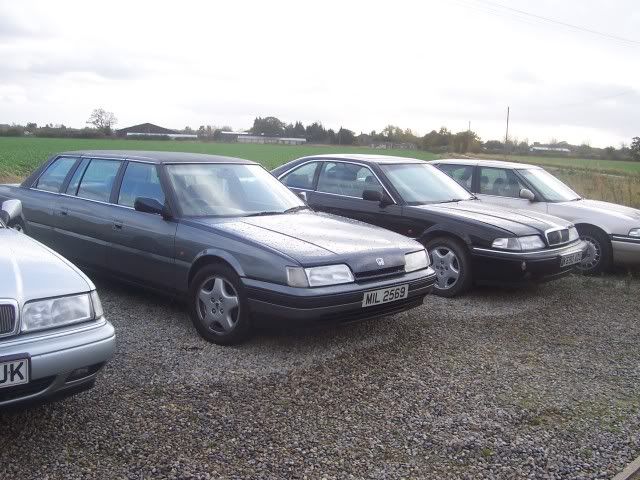
It was a MK1 827Si. Right engine, I'm not averse to MK1s, but perhaps the wrong spec for my liking - I'm into leather, so it would have to be a Sterling for me. The slight problem was that as I settled into the grey velour seat, I looked in my rear view mirror and saw the rear window some two and a bit feet further back than it would normally be. This was no ordinary 800, it was a Startins Regency limousine. And the owner was in the passenger seat. And I was to take it for a spin on some very narrow roads on a farm.

Let me recount the story as to how I got to be in this position. This was back in October, and my friend Mal Watson had invited me to what would be the last Rover 800 and Maestro/Montego enthusiasts' day out at his barn in Yorkshire, full off spares for anything you can imagine. We're talking a place with a Bond Equipe in 2 pieces amongst it's contents, the MG Maestro Turbo prototype, and an MGBGT shell on a shelf on the far wall. The reason this was to be the last is because Mal has since moved to Somerset after a change in circumstances. At this event, I met Chris Ellis - a chap I've known on various Rover 800 forums, who has just under a million 800s including (at the time) a Regency.

I asked him how it felt to drive compared to a standard 800, and his response was to invite me to have a spin. Well, could I really say no? Setting off, my concern was that I was turning right - immediately to my right was the daily driver of my good friend Richard Moss, a silver LPG-equipped 820Si. Not that I should have worried, for I found the steering of the 800 to be fingertip light, and the car felt no bigger than my daily 306. Indeed, it felt smaller than the Montego 1.6 Mayfair I was to drive the same day. It also felt smaller in that I seemed to be sitting lower, holding a larger steering wheel - this car was made as a tool of pleasure as much as a mode of transport.

To turn, I spotted a driveway some nine feet in width or so, which seemed ideal. And it was, but for the dog stood behind the car. I slid the exquisite gear selector into reverse, half-hoping that the sudden appearance of white lights would make the dog think this large creation was in fact a UFO, and thus run away. This failed. So Chris hopped out, and went to move the dog - which as a result attached itself to him like a limpet for the rest of the day. Backing up was just as easy as going forwards - the Regency may be large but visibility is second to none. As I parked again, I reflected upon the possibility of 800 ownership. He's since parted company with the regency, and had I the space I'd have bought it. But an 18 foot long car isn't practical.

A sixteen foot one, though, is a different matter. Now, where did I put the ad for that £250 Sterling Coupe?

Friday, 5 February 2010

Montego love

The Austin Montego 1.6 Mayfair; delightfully charming.


I nearly bought a Montego the other evening. Sight unseen, a 1988 Vanden Plas 2.0i automatic, in Diamond White over Hurricane Grey. I've known the majority of the car's owners since June 2006, and it only needed a little work to get back on the road. Sadly, it had gone by the time I asked about it, two days after being advertised on the Club site. Not that I had anywhere to store it anyway.

I blame my mate Ray.

Well, if I'm honest, blaming Ray isn't fair. I've had a bit of a thing for Montegos since seeing the car I nearly bought, three years ago, in the hands of another acquaintance. Especially Mayfairs and VPs. So when Ray very kindly offered to let me take his 1.6 Mayfair - in Clove Brown with a Caramel interior for all those in the Brown Car Appreciation Guild - for a quick spin, I wasn't going to refuse.

It's said you make your mind up about a car within the first ten seconds of getting into it. If this is the case, the Montego made a very favourable impression. No, the seats were not leather, but there was wood, it was brown, and let us not forget this car's place in history. The Montego was the last wholly British mainstream production car - the last Austin Rover with no Jap or Jerry input.

I'm a huge fan of automatic gearboxes, and since passing my driving test six months before taking the wheel of the Monty I'd not driven a car with a do-it-yourself 'box. I was thus concerned I'd make a hash of it. Not so. The clutch was forgiving, with a comfortable bite point, the gearbox was smooth, and the car was comfortable enough to make me forget I was in unfamiliar territory. It's spacious too, with ample headroom even for my 6'3" frame. Visibility from the car was second to none, especially out of the back, and I found myself liking it.

What I wasn't prepared for was the steering. Perhaps it's because I'm used to having power assisted steering. Perhaps (though I'd hate to admit it) it's because I'm a limp-wristed fairy with arms like toothpicks - weak, thin, and brittle. But I was unprepared for the initial weight of the steering. It freed up nicely when on the move, however, and I was able to consider more thoroughly my opinion of the car.

One more criticism. I'm a creature of habit, and if I am driving a manual car I like reverse to be underneath fifth in the gate. Whilst I'm happy to put up with a reverse gear next to first instead, I did not like the idea of pushing the lever down, rather than pulling up or leaving as is, to engage it. I admit, it took a minute or two of befuddlement before I gave in and just read the gearknob to discover the art of selecting reverse. But in a car with a proper 'box this would not prove a problem.

It's even comfortable and quiet on the motorway - I've been in noisier and less refined Jaguars. Whilst I admit there was a draught coming from somewhere round the passenger door frame, I'll give it the benefit of the doubt and assume a faulty seal is the cause, not a poor design. I had trouble believing the car was 23 years old, built to a 25 year old design.

Would I buy an Austin Montego? If you look to the top of this article you'll see I nearly did. One with leather to satisfy my love of the upmarket, with PAS to rescue my weedy little arms, and an automatic gearbox to satisfy my lazy side. And if a Yorkshireman is willing to put his money where his mouth is, you can rest assured he's suitably impressed.

Wednesday, 27 January 2010

The 306, six months on.

Peugeot's 306. A cracking buy.

Six months ago, I wrote a piece telling everybody in the market for a cheap car to buy a Peugeot 306. At this point, I'd run one for perhaps two months. Do I still feel the same, six months down the line? There's only one way to tell, and that's to look at it objectively.

I found a matching car - indeed, the one pictured above - with twice the mileage but three years newer a plate. That said, it was a late registration in that colour and as a MK1. That car is £950. Given that we paid £1500 in 2003, and I see no reason to sell for less that the car pictured, it has cost under a hundred pounds a year in depreciation. That's as close to depreciation-free motoring as what was then an eight year old car can offer.

It's quick enough, being powered by a 1.8 four of some 103bhp. The automatic gearbox provides a decent kickdown - not so much in terms of outright urge but I suspect this is more down to the car's age and the fact that short journeys do not endear themselves to peak engine condition. I always feel as though I'm in control too - drive a 306 and you understand instantly why the GTi6 was THE hot hatch to beat in the 90s.

I needn't repeat words I wrote six months ago, and which are freely available on this blog if you're interested. Suffice it to say the car is economical, spacious, airy, and scrubs up incredibly well for a 15 year old family hack. The radio is again excellent, with either a column stalk or buttons within reach which can be used to adjust the sound without taking your eyes from the road.

Another advantage to an automatic gearbox I could not foresee is it's usefulness in injury. In August I managed to damage the ligaments of my left ankle rather badly. My limp was rather pronounced despite the fact I tried concealing it from family members and friends, yet I was still able to drive in complete and utter comfort.

I mentioned the unique build quality of the French - and really, it's not as bad as I made it out. Yes, one piece of trim is held on with Blu-Tack. Yes, one piece until recently resided in the glovebox. But said piece, following some nifty modifications with a penknife and a file, went where it should have been from the factory. A bit of tape to secure the fix lest it break again did the job, and the car is now as close to concours (but filthy - I never wash cars in cold weather) as it can be. I'm still looking for a replacement steering wheel, incidentally - if anyone has a good beige four spoke wheel for a 306, get in touch.

If anything, my praise for Peugeot's peppy people's car is higher than ever. I really do understand the car's appeal, and for the ridiculously low sums they command now, as a Bangernomics advocate I heartily recommend you buy onewhilst there are still some decent ones left.